

How Deep To Set Tip Ups For Pike
Pike Ice Fishing With Tip Ups (Detailed Guide)
UPDATED 20 November 2022
by Bill Laney
Tip up fishing regularly produces more trophy northern superhighway during winter than any other ice fishing tactic, and pike are traditionally the well-nigh popular species caught with tip ups during ice line-fishing season.
Hither we'll cover the basics of how to ice fish for pike with tip ups, besides as our best tips and tactics to grab more state highway with this highly constructive ice fishing method.
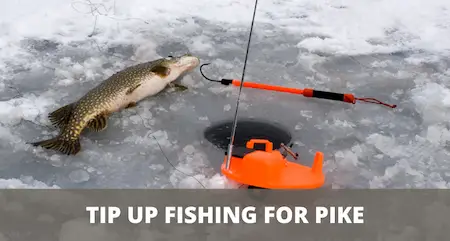
How to rig a tip up for pike
First let'due south talk about how to set upwards state highway tip ups. Assuming that you already know the basics of tip up fishing (if you lot don't, take a quick await at our ultimate guide on tip upwardly fishing), the chief questions we need to address are: what line and leader should you use, and what rig works best for targeting pike with tip ups?
Now let'southward look at each of these topics in more than particular.
Best tip up line for Pike
The best tip upwardly line for Pike is 30 to l lb test Dacron braided line. Dacron is generally an ideal choice for tip up angling, since it has more than stretch than regular braid. This improves its coiling behavior, and allows line to be released from a tip up spool without resistance when a pike grabs your allurement.
For regular sized freeway (up to fifteen pounds or so), 30 lb exam Dacron is plenty stiff, simply if yous're expecting to hook some monsters northward of xxx pounds, it'south better to go with fifty or threescore lb examination Dacron.
Continue in heed that pike put upwards a hard fight, and when y'all're fishing with tip ups, the line will chafe against the lesser edge of your ice angling hole whenever a stiff fish pulls on information technology. This is different from fishing with a rod and reel, where y'all can dip the tip of the rod into the water ice hole to foreclose line chafing. Too, in club to avoid the line cutting your easily, it's best to wear gloves while fighting a big throughway.
Tip up leaders for thruway
Virtually anglers use metal leaders when targeting pike with tip ups, because the dense rows of abrupt teeth in a expressway mouth can easily finish up cut your fishing line if you lot're using fluorocarbon or monofilament. By using a metallic leader, you can forbid losing quality fish due to line breakage.
In my experience, a tieable wire leader is best for this purpose, as it allows you to tie your ain metallic leaders, and cull custom hook sizes and spacing. As well, most store-bought metal leaders tend to have huge snap swivels at their finish, making them highly conspicuous in the water.
Tieable wire leaders are normally fabricated of single strand titanium, which behaves most like a monofilament line in terms of its stretch and coiling behavior, and this makes it easy to tie a hook or swivel onto information technology. It'due south best to prepare a bunch of DIY metallic leaders earlier you go out on the ice.
Metal vs fluorocarbon leader for pike tip ups
If you're fishing in clear h2o (or if the local motorway population regularly gets hammered with lots of angling pressure), information technology's likely that using a metal leader will produce fewer bites considering information technology spooks the fish. In that case you tin can replace the metal leader with a 50 to 80 lb test fluorocarbon leader.
Fluorocarbon is generally more than chafe resistant than monofilament, and therefore has a skillful chance of surviving contact with precipitous pike teeth. And while a fluorocarbon leader isn't 100% condom from beingness cut past pike teeth, you should be able to land most of the fish you claw, and you volition probably become a lot more bites, since fluorocarbon has low visibility underwater.
If y'all do determine to go with a fluorocarbon leader, recollect to run your finger along the leader afterwards every pike you catch, and cheque for small cuts, notches and rough patches. If you lot find any of these, swap out the rig with a fresh one, to avoid losing your side by side fish.
Quick strike rig for pike tip ups
The best rig to utilize for pike tip up fishing is a quick strike rig, which consists of two hooks spaced about 3 to 5 inches apart on a leader. I of the hooks is fastened to the head of the bait fish, and the other ane is attached either to the tail or the dorsal fin. Traditionally, quick strike rigs were made with a metallic leader, merely recently many anglers are tying their quick strike rigs with fluorocarbon.
Encounter also: How to rig for expressway ice angling
The original quick strike setup consisted of ii treble hooks, but some anglers prefer to use a unmarried hook equally the dorsum hook (the ane that is attached to the tail or dorsal fin). This is because pike usually swallow their prey head first, and as a upshot they are most always hooked but past the front claw. And when you try to pull a superhighway through an ice hole, the dorsum hook of the quick strike rig can get caught on the bottom border of the ice hole, causing you to lose the fish.
A large advantage of the quick strike rig is that information technology allows y'all to hook a expressionless bait fish in such a way that it lies horizontal in the water, which pike seem to discover much more attractive than a allurement fish hanging vertically in the water.
How deep exercise yous set up tip ups for thruway?
The best all around depth to set your tip ups for pike is in the middle of the h2o cavalcade, halfway between the bottom and the surface. For example, in 20 feet deep water, set the depth of your tip up to 10 anxiety.
While this is a good dominion of thumb to get you started, you should besides attempt to test a range of unlike depths with your tip ups, in order to find the ideal depth on a given day. The best style to do this is by dividing the water cavalcade into 3 layers (bottom, middle, and shallow), and targeting each layer with a couple of tip ups.
Unlike walleye (which stay shut to the bottom almost of the time), pike are known to hunt throughout the entire water column, and yous tin can catch them at almost whatever depth. On some days, you'll catch pike only 2 feet beneath the ice, while on other days yous'll discover them sticking closer to the bottom.
See also: ice fishing for pike (complete guide)
Once you lot start getting several bites at a similar depth, modify all your tip ups to that depth. And when the bite dies downward, start testing dissimilar depths once once again. Throughway also similar to pick upwards dead bait fish from the bottom, so it's always worth setting upwards several tip ups with the bait lying straight on the bottom.
Finally, y'all can also use a sonar and/or underwater camera to determine the depth at which superhighway are holding on a given 24-hour interval.
All-time bait for freeway ice angling with tip ups
The best bait to use with tip ups for thruway are live or dead bait fish between three and vii inches long. The most normally used species are suckers, shiners and minnows as live allurement, and ciscoes, smelt, mackerel or herring as expressionless bait.
Pike are scavengers, and peculiarly during the common cold season they like to consume dead fish. You tin exploit this behavior by setting up your tip ups with a variety of unlike expressionless allurement fish, to determine which one works best for you. If possible, try to get freshly caught oily fish species (such as mackerel or herring), as they produce a scent that'southward often irresistible for expressway.
Tip upwards tactics for freeway
The nifty thing almost tip up fishing for freeway is that you can use information technology to encompass a large area, as well as testing different depths and baits, and this allows you to zero in on the most effective tactics.
The primal cistron for success with tip up fishing for freeway is finding the correct locations. The most of import thing here is to stay mobile until you find the fish, and to use every tool that can help you lot with this: lake profile maps, GPS, flashers, and underwater cameras. And concluding but not least, you tin also ask at a local tackle shop where the all-time spots are. If you don't become any bites at first, that often means you need to move to a unlike location.
A slap-up strategy to detect pike is by locating their prey. For example if yous find mud flats with weed growth, these are likely to concenter schools of bluegill, yellow perch and minnows. And if you locate big concentrations of bait fish, y'all can be certain that pike are likely to be nearby.
Ever make sure to actually check for the presence of baitfish. The all-time way to do this is with a camera, such every bit a Marcum or AquaVu underwater camera. This will evidence y'all unequivocally if there are bait fish around, but you'll also be able to spot if there are any pike in the surface area, which gives you absolute certainty earlier you gear up up your tip ups.
When targeting weed flats, it's usually best not to ready up your tip ups correct on top of the weeds, equally your bait will be hidden inside the vegetation. Instead endeavor to find the edge zone of the weed flat facing deeper water, and place your tip ups along that edge. Often this outer edge of the weed flat is a drib-off contour line, and this tin be an ideal location to find big throughway.
When you place your tip ups along a drop off, attempt to apply a zig-zag blueprint, with some tip ups positioned right on top of the driblet off, and some to either side of information technology. When you notice that specific spots produce more bites, drill more holes in similar locations, and reposition your tip ups to those holes to maximize effectiveness.
Besides keep in mind that state highway movement to dissimilar locations during belatedly water ice. These are commonly flats located close to their spawning grounds in shallow trophy and creek inlets.
Additional resources:
- What is the best flasher for water ice line-fishing?
- Ultimate beginner'due south guide to ice fishing
- What are the all-time ice fishing lures for pike?

How Deep To Set Tip Ups For Pike,
Source: https://sportfishingbuddy.com/tip-up-fishing-for-pike/
Posted by: baileysitted.blogspot.com
0 Response to "How Deep To Set Tip Ups For Pike"
Post a Comment